

Last updated on April 2026
BLOG
PEPPOL – A Universal Transmission Channel for Secure Digital Invoice Exchange
Peppol is a standardized network designed for the secure, interoperable, and cross border exchange of electronic invoices and other e procurement documents. It eliminates custom interfaces and media disruptions, offering an internationally unified and compliant communication framework.
Max. Reading time 24min Published May 12, 2020
If you are looking for a reliable transmission channel for digital invoice exchange, Pan‑European Public Procurement Online (Peppol) is the right choice. Here, you will find everything you need to know from the perspective of invoice recipients.
The Essentials at a Glance
What Is Peppol? More Than Just a Transmission Channel.
Peppol is not a platform, but a standardized network designed for the secure and interoperable exchange of e‑invoices. The Peppol network is built on access points, known as “Access Points.” They provide the standardized transmission channel for electronic invoices between the invoice‑processing systems of participating parties.
Peppol is based on clearly defined technical specifications (Peppol BIS) and a central participant directory. In addition, mandatory network rules apply, which Access Point providers pass on to their participants. These rules ensure that all parties communicate according to the same standards – regardless of which Access Point they use.
For you, this means: All you need is a networked access point to exchange not only e-invoices but also other relevant documents for procurement processes. And you can do this worldwide with any participant: clearly structured, secure, reliably delivered, and internationally standardized.
The 4‑Corner Model: How Your Data Flows Securely
The Peppol network is built on a clear architectural principle: the Four‑Corner Model. It ensures that all participants communicate according to the same rules, regardless of which ERP system or service provider they use.
In the Peppol model, two Access Points handle the transmission of e‑invoices and the routing between sending and receiving organizations. The network itself consists exclusively of these Access Points. Participating companies connect only to their own Access Point. Direct point‑to‑point connections are completely eliminated.
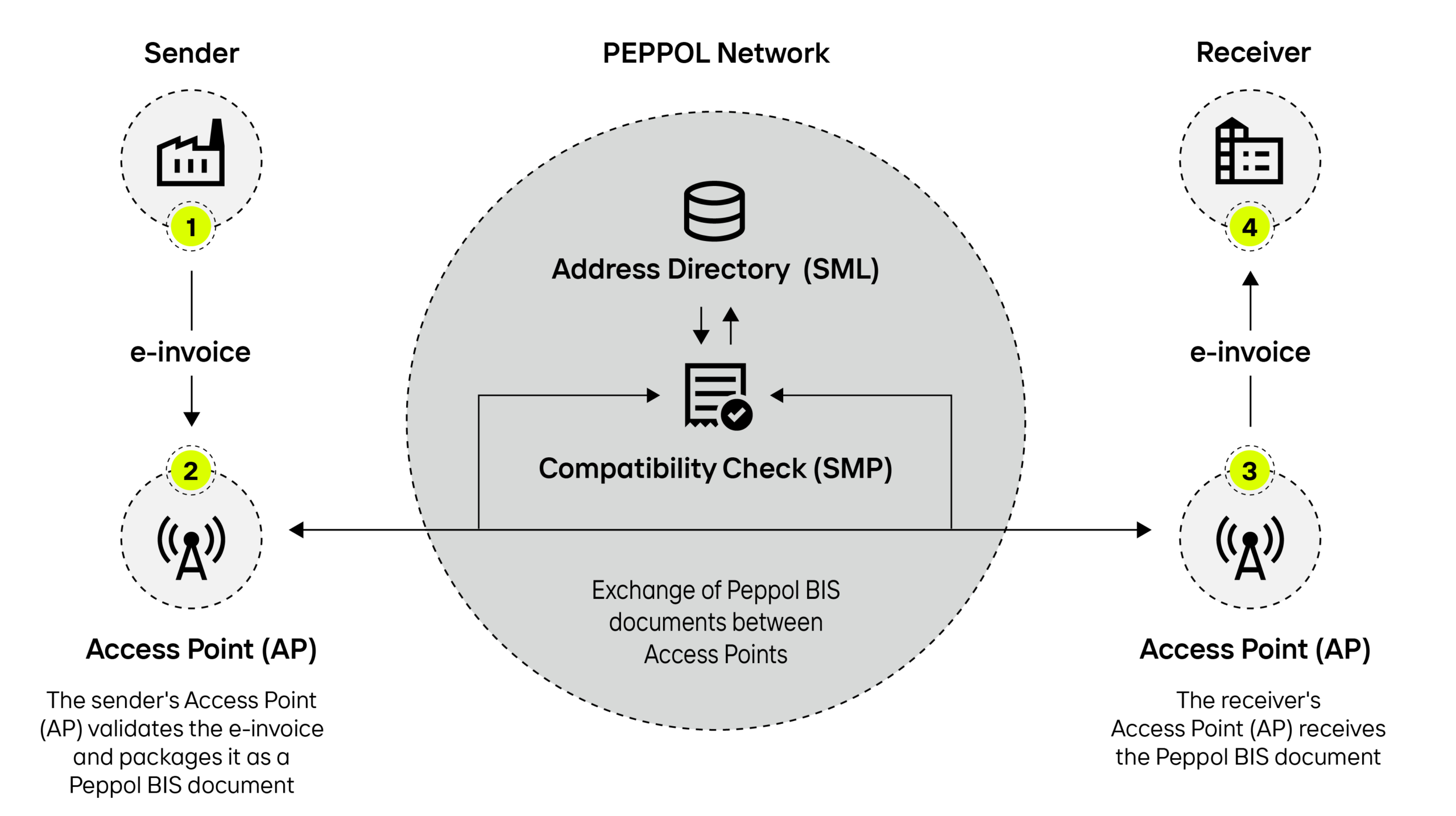
The advantage: A single connected Access Point is all it takes to securely reach any other company or public authority within the Peppol network. Validation, structured data formats, and guaranteed delivery are built into the Peppol standard and do not depend on the individual system.
Why Peppol? Advantages Over Email
Email is widely used for exchanging invoices, but it is not technically designed for this purpose. Messages are transmitted using a best‑effort approach, meaning they are considered delivered even if they never reach the recipient.
Peppol replaces this unreliable email transport with a structured, validated, and reliably delivered transmission channel. This reduces errors, ensures data quality, and creates clear traceability.
Hope‑Based Processing vs. Peppol
Still waiting or already booking? Statistically, 2 to 5% of B2B emails disappear unnoticed due to “silent dropping”. For you, this means missing documents, manual follow‑ups, and missed payment deadlines.
Peppol replaces email’s unreliable “best‑effort” principle with guaranteed delivery directly into your accounting system.
The Benefits at a Glance:
- Guaranteed delivery: Peppol confirms receipt of the e‑invoice, email does not.
- No media discontinuity: invoices arrive already structured and do not need to be checked or processed manually.
- Standardized formats: Peppol relies on validated e‑invoicing standards (EN 16931, Peppol BIS). Email does not provide any format specifications.
- Fewer sources of error: No spam filters, no PDF variants, no missing attachments.
- Interoperable: Once connected, you can communicate with any Peppol participant worldwide.
- Secure: Data exchange occurs via certified Access Points, not through an open communication protocol like SMTP.
In short: Peppol enables reliable, traceable, and standardized invoice exchange, something email cannot deliver from a technical standpoint
How Do I Set Up a Peppol ID for My Organization?
To ensure your organization can be reached within the Peppol network, you need a unique Peppol ID. It functions as a digital address and links your organization to the Access Point through which you receive and send invoices. The best part: Your selected Access Point provider handles the entire setup.
- Choose an Access Point
A certified Access Point manages the registration and technical onboarding. Direct registration with Peppol is not possible. Peppol.org provides an overview of certified providers. - Provide your company information
This typically includes the legal company name, address, VAT ID or GLN, and the desired receiving format. The Access Point registers this information in the central participant directory. - Receive and activate your Peppol ID
Once registered, your organization becomes discoverable in the network and can immediately receive e‑invoices in the Peppol standard – without any technical setup on your end.
Peppol ID & Addressing: How Are You Located in the Network?
To be reachable within the Peppol network, you need not only a Peppol ID but also a correct entry in the central participant directory. This directory is called the SMP: Service Metadata Publisher. It functions like an address book: every organization is listed there with a unique ID that defines which Access Point it can be reached through.
Addressing happens automatically. Once your Access Point provider registers your data, other Peppol participants can find you and send you e‑invoices. Senders do not need to maintain their own master data or manage individual target addresses. They simply rely on the current entry in the directory.
For organizations, this means:
Your company is uniquely identifiable across the entire network. Invoices are delivered correctly, even if internal systems or contacts change.
Connecting to Peppol in 3 Steps
Once you have selected your Access Point, provided your company information, and received your Peppol ID from the Access Point provider, the actual technical integration begins. It ensures that e‑invoices reach your internal systems reliably and automatically.
1. Set up the receiving channel
Your Access Point provider connects Peppol with your ERP, DMS, or invoice‑processing system. Depending on your system landscape, APIs, connectors, or standardized interfaces are available. As a result, e‑invoices enter your processes in a structured format without manual steps in between.
2. Activate and test your Peppol ID
Once your entry in the participant directory is active, a brief testing phase begins. This ensures that invoices can be delivered correctly and processed end‑to‑end.
3. Go live
After a successful testing phase, you can start receiving e‑invoices in the Peppol standard. All ongoing data exchange runs entirely through your Access Point without any additional technical effort on your part.
ECM & Peppol: The easy Mail Gateway as a Hybrid Hub
The easy Mail Gateway consolidates all incoming invoice formats into a single entry point. It processes paper invoices from scan‑in workflows, traditional PDFs, and structured e‑invoices such as XRechnung and ZUGFeRD. During the third quarter of 2026 Peppol will be added as an additional transmission channel. This allows the gateway to bring all incoming channels together into one digital processing chain regardless of how suppliers submit their invoices.
Especially in the context of Germany’s e‑invoicing mandate, this hybrid approach is essential. Because requirements and deadlines take effect gradually, invoice recipients must realistically expect paper invoices and non‑EN 16931‑compliant formats throughout 2026 and 2027. Many suppliers will transition only with delays or rely on transitional rules. The easy Mail Gateway absorbs this variety and ensures that every invoice is reliably delivered into the ECM or workflow system.
With the Peppol integration, the inbound channel is expanded by a secure and structured standard. E‑invoices arrive already validated and in the correct format, without manual steps or format adjustments.
Peppol Delivers Convenience and Security
Peppol simplifies invoice exchange while increasing security. For invoice recipients, this means less coordination, fewer errors, and more transparent processes. Every invoice arrives in a structured format and can be processed immediately, regardless of which Access Point the sender uses.
Die wichtigsten Vorteile:
- Invoices are delivered reliably.
Unlike email, Peppol messages are delivered with guaranteed receipt. Issues caused by spam filters, mistyped addresses, or lost emails do not occur. - Invoices remain unchanged.
Peppol uses digitally signed documents, ensuring that invoices originate from the sender and have not been altered in transit. - Lower phishing risk.
Peppol does not transmit freely formatted emails, links, or file attachments. Senders are clearly identifiable; fraudulent messages or manipulated PDFs do not enter the invoice inbox. - Standards ensure compatibility.
As long as an invoice complies with EN 16931, Peppol handles the transmission without extra coordination. Individual format agreements are unnecessary. Within the standards, Peppol acts like a “universal translator.” - Network discoverability.
Through the central Peppol participant directory, you are uniquely addressable. Senders do not need their own contact lists or separate receiving addresses. - Less rework in invoice processing.
Structured invoices can be validated, assigned, and processed more quickly than PDF or paper invoices.
In summary:
Peppol provides a clearly defined, secure, and standardized transmission channel for e‑invoices, an approach that causes significantly fewer errors than email and noticeably streamlines your internal processes.
B2B, B2G: In Which Countries Is Peppol Available Today?
Peppol wird international eingesetzt – im öffentlichen Bereich (B2G) ebenso wie im Austausch zwischen Unternehmen (B2B).
In Europe, Peppol is already established in many countries, including Germany, Austria, the Netherlands, Belgium, the Nordic countries, and parts of Southern Europe. Outside Europe, Peppol is gaining traction as well, for example in Australia, New Zealand, Singapore, and Japan.
For invoice recipients, this means: If suppliers operate internationally, the likelihood increases that they can – or soon will be required to – send invoices via Peppol.
Business to Government in Germany and Austria
In Germany and Austria, Peppol is an integral part of electronic invoice exchange with government agencies. Public authorities accept e‑invoices in EN 16931‑compliant formats, and many agencies receive them directly via Peppol. More details are available on the website of the German Federal Procurement Office (BMI).
In Austria, Peppol has been embedded in governmental transaction processes for several years. In Germany, Peppol is used, among other things, as a connection method for the central invoice‑receiving portals. This creates a unified channel that reduces format inconsistencies and technical exceptions.
For companies, this means: Anyone providing services to federal, state, or local authorities benefits from a clearly defined, stable, and standardized transmission channel through Peppol.
Business to Business: For Cross‑Border Transactions
In the B2B environment, Peppol becomes particularly relevant when German companies collaborate with partners in other European countries. Many countries already use Peppol for cross‑company invoice exchange often earlier and more widely than Germany.
For German invoice recipients, this means that invoices from abroad increasingly arrive via Peppol: structured, EN 16931‑compliant, and without the need for individual format agreements.
VIDA and Peppol: Where Are We Headed?
The EU initiative ViDA (“VAT in the Digital Age”) aims to harmonize value‑added tax collection across Europe. At the heart of the reform are structured e‑invoices based on EN 16931 and digital reporting systems for cross‑border B2B transactions. As a result, the requirements for secure, interoperable, and traceable transmission channels continue to increase.
This is where Peppol fits perfectly. The network already transports structured e‑invoices in a stable and standardized way. For German companies, another aspect becomes relevant: digital sovereignty. Many German Access Point providers operate their infrastructure within national jurisdiction, ensuring a data‑protection‑compliant and locally anchored gateway to the European Peppol network
In short: Peppol provides the technical foundation for digital sovereignty, an advantage that Access Point providers in Germany actively leverage.
Frequently Asked Questions About Peppol (FAQ)
Is the Use of Peppol Mandatory for My Company?
No. In EU member states, the use of Peppol is currently not mandatory for companies. Participation in the network is voluntary.
However, more and more EU countries are adopting Peppol for exchanging structured e‑invoices, especially in the B2G environment. In addition, the EU’s ViDA initiative further increases the importance of standardized formats and harmonized transmission channels. As a result, the likelihood rises that Peppol will be used more often in the future or expected by business partners.
In summary: Not mandatory, but increasingly relevant across the EU..
XRechnung vs. Peppol: What’s the Difference?
- XRechnung is an e‑invoice format.
- Peppol is a transmission channel.
XRechnung defines the content and structure of an e‑invoice according to EN 16931.
Peppol enables the secure and standardized transport of such invoices between companies and public authorities connected via Access Points.
Do I Need a Peppol Access Point or a Membership?
You need access to a Peppol Access Point, but you do not need a membership.
The Access Point provider handles the technical integration, the registration in the participant directory, and the provisioning of your Peppol ID.
Membership in OpenPeppol is not required. It is intended only for organizations that operate Access Points themselves or contribute to the development of the standard.
In short: Access to an Access Point is all you need..
How Do the 4‑Corner Model and the AS4 Protocol Work?
The 4‑Corner Model defines how Peppol transports e‑invoices. The sender and recipient never communicate directly; instead, each communicates only with their own Access Point. These Access Points handle routing, validation, and the secure forwarding of structured e‑invoices. This creates a standardized transmission path that works independently of the systems or formats used by the participating organizations.
The AS4 protocol is the technical standard used for communication between Access Points in the Peppol network. AS4 provides secure connections, unique identification, digital signatures, and tamper‑proof document transmission. For companies, AS4 remains invisible; it operates entirely in the background between the Access Points.
In short:
4‑Corner Model = Who communicates with whom?
AS4 = How is the transmission carried out technically?
What Is Peppol BIS Billing?
Peppol BIS Billing 3.0 is the internal exchange format for invoices within the Peppol network. It functions like a container that transports structured e‑invoices between Access Points. Companies do not interact with this format directly; they continue to work with their EN 16931‑compliant invoice formats (e.g., XRechnung, ZUGFeRD).
What Are the Benefits for Senders and Recipients?
- Unified technical foundation across all Access Points
The container ensures that all Access Points process the same data structure—regardless of the sender’s source system. - Consistent validation
Because each invoice is wrapped in the same container format, Access Point providers can perform consistent validations and return errors early, before the invoice is sent. - Reliable transmission
BIS Billing ensures that invoices are transmitted consistently according to the same rules, regardless of which ERP system or tool the sender uses. - Potential for additional services
The standardized container enables monitoring, reporting, and rule‑based checks without altering the invoice content.
What Is the Purpose of the Peppol ID?
The Peppol ID is your organization’s unique address within the Peppol network. It defines which Access Point you are connected through and which document types you are able to receive.
The central Peppol address directory (SMP, Service Metadata Publisher) also stores which e‑invoice formats and syntaxes your organization supports. This allows senders to address you correctly and send invoices in the appropriate EN 16931‑compliant format.
In a nutshell: The Peppol ID ensures that you are uniquely identifiable on the network and that e-invoices arrive in a format that your company can technically process.
What Is the Peppol Address Directory (SMP)?
The Peppol address directory, officially called the SMP (Service Metadata Publisher), is the public directory of all Peppol participants. It stores the information senders need to deliver invoices correctly. This includes:
- Peppol ID: the recipient’s unique address
- Document types the recipient supports (e.g., invoice, credit note)
- Invoice formats and syntaxes accepted (e.g., EN 16931 UBL)
- The Peppol profile in use (e.g., BIS Billing 3.0)
- The responsible Access Point including endpoint URL and certificate
The SMP ensures that every participant can be uniquely located in the network and that senders immediately know which format and profile they must provide.
In short:
The Peppol address directory is the network’s central lookup service. It shows who is reachable, how they can be reached, and which format they expect.
What Is Peppol SML?
The Service Metadata Locator (SML) is the central control component of the Peppol network. It determines where a participant’s metadata is stored. Sounds abstract? Think of the SML as a signpost that says: “You’ll find the information for this Peppol ID in the corresponding SMP.”
What Does the SML Do?
The SML manages the mapping between:
- Peppol participants, and
- the SMP (Service Metadata Publisher) responsible for them.
This ensures that systems reliably locate the correct SMP – and, indirectly, the appropriate Access Point for subsequent document delivery.
Why Is This Important?
Without the SML, the Peppol network would have no way of knowing where a participant’s technical receiving data is stored. The SML initiates the entire lookup process and enables the next step: retrieving detailed information from the SMP.
In short:
The SML points to the correct SMP. The SMP provides the receiving data. The Access Point ultimately handles the delivery.
How Does Peppol Perform in International Business? (Keyword: PINT)
Peppol is increasingly used worldwide, not only within Europe. To ensure that international business partners can reliably exchange structured e‑invoices, OpenPeppol developed the PINT format (Peppol International Invoice). PINT is an international extension framework based on EN 16931, designed for use beyond Europe.
This enables countries like Australia, New Zealand, Singapore, and Japan to send and receive Peppol invoices without having to develop their own national formats. For German companies, this means invoices from abroad increasingly arrive via Peppol: structured, interoperable, and without the need for individual format agreements.
In summary:
PINT makes Peppol globally interoperable. International partners can exchange e‑invoices under the same rules, regardless of their country.
Can Peppol be used for both sending and receiving?
Yes. Peppol supports both the sending and the receiving of structured electronic invoices. In both cases, access to a certified Peppol Access Point is required.
Whether you can only receive invoices or also send them depends on two factors: the functionalities offered by your Access Point Provider, and the process profiles (for example, BIS Billing) registered for your company in the Peppol Directory.
In short:
With access to a Peppol Access Point, companies can receive invoices and, if required, also send invoices via the Peppol network.
What Advantages Does Peppol Offer Compared to Portals or Email PDFs?
Peppol reduces media disruptions and automates electronic invoice exchange. While portals or email PDFs always require manual steps, Peppol transmits structured data directly between two systems. This results in less effort, higher data quality, and noticeably more stable processes.
Why is that?
- No portal logins: Time‑consuming uploading and retrieving of invoices across multiple customer portals is eliminated.
- Consistent data quality: Peppol transmits machine‑readable, standardized invoice data (EN 16931‑compliant) instead of unstructured documents.
- Secure transmission: Peppol uses the AS4 protocol for fully encrypted data exchange with digitally signed invoice documents.
- One access point for all: Once connected, organizations can reach all Peppol participants worldwide—without custom interfaces.
- Audit‑ready: The Peppol ID, defined profiles, and documented transmissions create transparency and traceability.
What does this mean for organizations?
Peppol shortens workflows, reduces errors, strengthens compliance, and provides a unified digital process—without the complexity of multiple portals or invoice variants.
Do I Need to Migrate My Suppliers or Customers?
In many cases: no. Peppol is designed so that both parties can communicate without major system changes. Anyone who already has a Peppol ID can immediately send or receive electronic invoices, regardless of which ERP or ECM system they use.
What does this look like in practice?
- Recipients do not need to change anything: If an organization is Peppol‑enabled, it can automatically receive invoices.
- Senders can start flexibly: Many solutions. including modern ECM and invoice platforms, can generate Peppol‑compliant data even if the upstream system does not support Peppol.
- No partner projects: No bilateral coordination or technical pre‑testing is required. The Peppol profiles and the 4‑corner model handle this automatically.
- Gradual rollout possible: Organizations can start in parallel with existing processes and adopt Peppol step by step.
What does this mean for organizations?
Peppol minimizes dependencies. There is no pressure to force suppliers or customers into new processes. Instead, each party can choose its own timing while still working interoperably from day one.
How Complex Is the Technical Integration Into My ERP or ECM?
The integration effort is usually low. To send and receive Peppol invoices, the endpoint of your chosen Access Point provider – where your organization is registered – is sufficient. Your ERP or ECM system only needs to provide or receive the structured invoice data; the Access Point handles the entire transmission.
What does this mean in practice?
- No in‑house AS4 implementation.
- No bilateral interfaces with individual customers or suppliers.
- Only one connection: ERP/ECM → Access Point endpoint.
- Standardized data formats (e.g., EN 16931) are sufficient.
In short:
Peppol integration is a routine task today. The technical complexity lies with the Access Point, not with the ERP or ECM system.
How Secure Is Peppol?
Peppol is designed for the secure exchange of business‑critical documents. The network relies on verified identities, certificates, and the AS4 protocol, which was developed specifically for secure B2B data transfer. This ensures that invoice data remains confidential and protected from manipulation during transmission.
Key Security Features
- Encrypted transmission: The AS4 protocol ensures that messages between Access Points are both encrypted and digitally signed.
- Certificate‑based identities: Access Points and participants use verified certificates; every Peppol ID is uniquely assigned.
- Closed infrastructure: Exchange takes place through accredited Access Points within a defined network, and not via open email traffic. This eliminates phishing risks through this channel.
- Logging and traceability: Transmissions can be traced and documented in an audit‑ready manner.
- Standardized profiles: Uniform specifications reduce misconfigurations and ensure consistent security levels.
In short:
Peppol provides strong technical protection for invoice data in transit. The combination of certified Access Points, encrypted transmission, and verified identities ensures a transparent and tamper‑proof exchange. This is significantly more secure than traditional email‑ or portal‑based processes.
What Happens If My E‑Invoice Format Doesn’t Match?
If your e‑invoice format does not meet the recipient’s requirements, such as the EN 16931 structure or the format listed in the Peppol address directory, the invoice will be rejected by the Access Point. It will not enter the Peppol network.
The Access Point provider performs validations before sending and reports errors directly back to the sender. These may include:
- missing mandatory invoice fields
- incorrect syntax
- invalid values (e.g., date formats, totals)
- unsupported document types or process profiles
Corrections must be made on your side; Access Points are not allowed to modify business content. Only once your invoice is valid will it be transmitted through the network as a Peppol BIS Billing payload.
In short:
Invalid or non‑compliant e‑invoices are not delivered but rejected upfront – with a clear error description.
What Is the Difference Between Peppol and Traditional EDI?
- Peppol is an open, standardized network for exchanging structured e‑invoices. It uses fixed formats (e.g., EN 16931), defined process profiles, and a central address directory. All transmission occurs through certified Access Points.
- Traditional EDI, by contrast, relies on individual point‑to‑point connections. Formats, protocols, and mappings are negotiated separately between partners and require ongoing maintenance.
In short:
Peppol is a unified, interoperable network.
EDI requires individually negotiated – and often complex – partner integrations.
What Costs Should I Expect for Connecting to Peppol?
The costs for connecting to Peppol in Germany depend on the Access Point provider. In general, they consist of three components:
- Setup:
Registration of the Peppol ID, entry into the Peppol address directory (SMP), and technical activation at the Access Point. - Ongoing fees:
Operation of the access to the Peppol network (certificates, endpoint management, monitoring) - Optional transaction fees:
Some providers charge per sent or received message; others offer flat‑rate models
Important:
Organizations do not need their own technical infrastructure, their own Access Point, or any AS4 configuration. The entire technical operation is handled by the German Access Point provider.
In short:
You pay a one‑time setup fee, an ongoing base fee, and—depending on the provider—small transaction fees.
Which Document Types Can I Transmit via Peppol?
Peppol is not limited to e‑invoices. The network supports a range of additional structured documents relevant to procurement processes. These include:
- Orders
- Order responses
- Despatch advice
- Credit notes
- Catalogues and price lists
- Invoice response messages
The document types an organization can receive are listed in the Peppol address directory (SMP). Senders can use this information to select the appropriate document profile.
In summary:
Beyond e-invoices, Peppol supports all essential documents required for an end‑to‑end digital procurement process.
What Is OpenPeppol?
OpenPeppol is an international non‑profit association (AISBL) based in Brussels. It develops the technical standards for the Peppol network (such as Peppol BIS Billing and AS4), defines the rules for data exchange, and certifies Access Point providers. However, OpenPeppol does not operate the network itself and is not a technical service provider.
Membership in OpenPeppol is only relevant for organizations that operate Access Points themselves or want to contribute to the further development of the Peppol standard. Companies that simply want to send or receive invoices do not need to be members of OpenPeppol.
In summary:
- OpenPeppol defines the rules and standards of the Peppol network.
- Access Point providers operate the technical infrastructure.
- Companies use Peppol simply via their chosen provider.